How do you develop a team from a high-performance team to a real high-performance team?
Together with a successful German car manufacturer, Strametz has designed a two-day High Performance Team Training course that combines theory, potential diagnostics and a realistic high performance simulation into an intensive development process.
The requirement was clear: in an environment that stands for precision, innovation and the highest quality standards, a real high-performance team should not only secure its performance, but also develop it further in a targeted manner. The training therefore focused not only on imparting knowledge about high-performance teams, but also on experiencing high performance live under time pressure, with challenging complexity and real reflection loops.
“High performance has been redefined for me. It’s not about working at the limit all the time, but about using resources intelligently as a team. This has changed the way we work together in the long term,” was one enthusiastic participant’s feedback.
Making High Performance Measurable and Developable Using the High Performance Maturity Profile
The first day of training focused on the question: “What distinguishes true high-performance teams from high-performing teams?”
Using our maturity profile for high-performance teams —which includes ten specific competencies, each with three subcriteria and defined behavioral anchors—the participants developed a shared understanding of what constitutes true high performance within a team. The visualized maturity levels served not only as a theoretical guide but, above all, as a tool for observation and reflection. This made it possible to systematically identify strengths and areas for development. This shared language served as a common thread running through all the exercises, feedback loops, and the subsequent simulation.
Identifying High Performance in Live Exercises
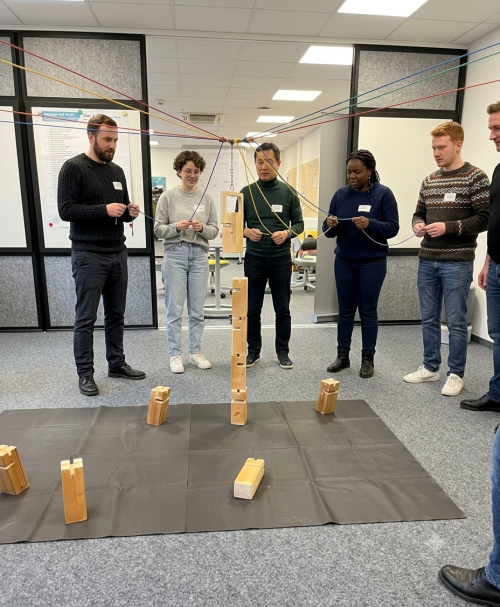
After the introduction to the characteristics and criteria of high performance teams, the participants immediately experienced the collaboration in practice. In the interactive “Tower of Power” exercise, the team acted according to clearly defined criteria for high-performance teams and systematically reflected on their own performance:
- How clearly are our roles distributed?
- How do we make decisions?
- How precise is our communication?
- How do we deal with mistakes?
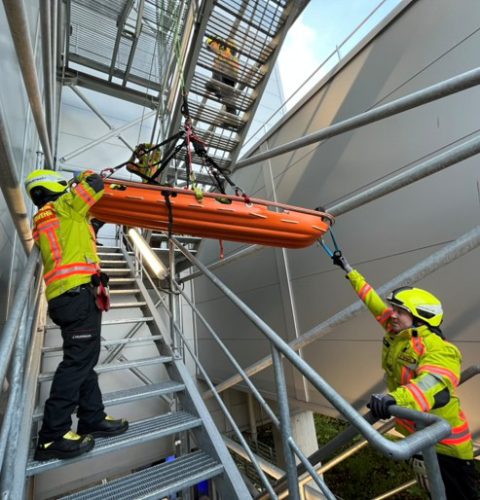
A special highlight was the live experience of high performance in action:
The participants observed the plant fire department during a rescue at height and a rescue in a fogged room. Together with the emergency services, they then reflected on key success factors such as
- Communication discipline under pressure
- Absolute role clarity
- Trust in competencies and roles
- Dealing constructively with mistakes
This direct observation of professional high performance created a strong reference image and made it clear how much structure there is behind an effortless and well-rehearsed performance.
Understanding Personality and Improving Performance
The second day focused on the individual potential of all team members and the question of how individual potential can be optimally combined and used in the team. The participants learned about the personality profiles (Big Five) of all team members and experienced how different thinking, decision-making and communication patterns are shaped. In addition, the previously created Affinity Profiles® of all team members were analyzed in depth.
The decisive step was to derive concrete synergies:
- How do we make targeted use of complementary personality traits?
- Who takes on which role based on potential instead of hierarchy?
- What rules support our cooperation?
This resulted in a shared understanding of strength-oriented teamwork – away from randomness and towards the conscious use of roles and skills.
The participants also experienced themselves and their teamwork in a real high-performance simulation in which they put into practice the theoretical content, the findings from observing the fire department and their knowledge of the potential profiles of all team members.
Team Simulation: High performance under real conditions
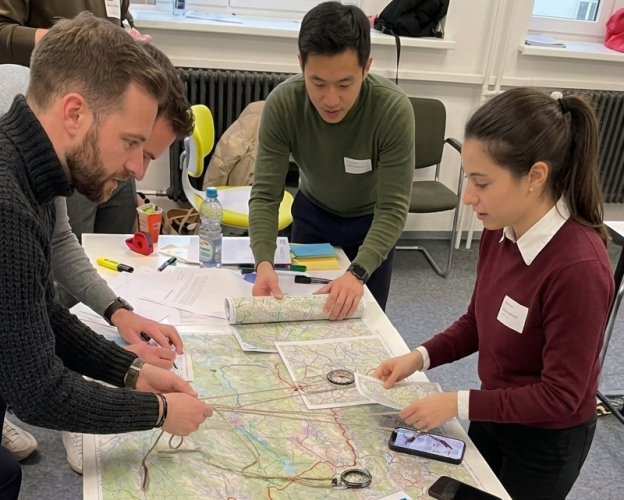
The highlight of the training was the High Performance Team Simulation. The participants were faced with complex challenges that could only be solved through optimal teamwork, precise communication and a potential-oriented distribution of roles. The simulation was deliberately designed to be realistic:
- High time pressure
- Complex tasks
- Limited communication options
- unexpected obstacles
These conditions called for “real high-performance mode”. Democratic voting or long discussions did not lead to the goal – clarity of roles, targeted and focused communication and striving for excellence were required.
Through targeted optimization reflections within the simulation, the participants improved their performance step by step. The focus was not only on better results in the simulation, but above all on the transfer to real project work.
At the end of the training, the team formulated binding commitments for the next 1.5 years of collaboration – concrete, measurable and strategically oriented.
Measurable results & benefits for participants
The changes brought about by the High Performance Team Training with simulation were clearly visible – both in terms of behavior and attitude. In summary, the High Performance Training brought the following results:
- Make targeted use of potential
All team members now know the personality and affinity profiles in the team – and use them consciously and complementarily for optimum performance. - Professionalize decision-making processes
Initial democratic voting processes have been transformed into competence- and role-based decision-making processes with clear, comprehensible criteria. - Transforming communication
Long, aimless discussions gave way to precise, appreciative and results-oriented communication. - Strengthening the focus on excellence
Being satisfied with “good enough” has become an authentic pursuit of excellent results. - Boosting self-confidence & confidence
Instead of emphasizing obstacles, the team developed an optimistic drive and confidence in their own skills. - Building trust & psychological security
Superficial knowledge gave rise to well-founded trust. Skepticism gave way to emotional security – including the courage to openly address mistakes and introduce new ideas.
One participant from project management describes the high performance training as follows:
“I had the feeling that we were achieving a lot, but not always in the same direction. The training helped us to focus our energy. Today, we speak more clearly, make decisions faster and are noticeably pulling in the same direction.”
Another participant from the development sector emphasizes personal insight:
“Understanding the different personality profiles was particularly valuable for me. I now see my team from a strengths perspective – and that makes a noticeable difference to the way we work together.”
Highest relevance for HR, L&D and management
This project shows impressively that high performance does not happen by chance – it can be trained. For HR decision-makers, learning & development managers and management, this means:
- Anchoring high performance as a strategic development goal
- Systematically combining team performance with sophisticated potential diagnostics
- Using simulations as a powerful learning format
- Securing transfer through binding commitments
Especially in highly competitive environments, the targeted development of high performance teams becomes a decisive competitive advantage, as these teams are able to overcome challenges more efficiently and thus increase the company’s success.
Conclusion: From a high-performance team to a genuine high-performance team
The High Performance Team Training with simulation at our client in the automotive industry shows how personality work, realistic simulation and structured reflection can have a lasting effect.
Strametz supports companies in systematically building high performance teams, professionalizing decision-making and communication structures and establishing a performance-enhancing culture with genuine psychological safety.
Do you want to get your teams into real high-performance mode? Let’s talk about it!