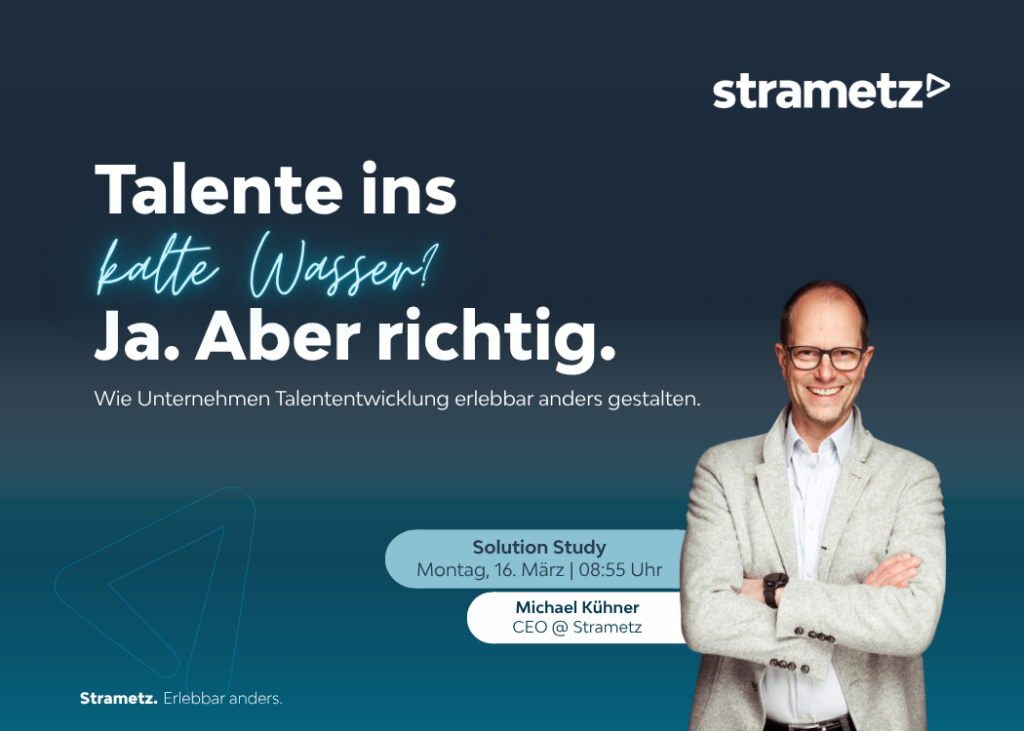
“Throwing in at the deep end” – this is the unspoken development strategy for junior managers and talented employees in many companies. The hope behind it: They will learn to swim. Unfortunately, the reality that we experience in practice every day is very different.
Talent development in practice: When hope becomes a strategy
Some talents really do develop quickly. Many struggle silently. And valuable potential remains untapped – not because people don’t have it in them, but because the framework conditions for their development are lacking.
It was precisely this topic that led to intensive discussions at Talent Management Reloaded DACH in Berlin. What we experienced there: The discomfort with traditional development formats has long since arrived in the HR community. Management development consisting of a single seminar, talent programs without consistent support, potential diagnostics without a link to specific development plans – many HR decision-makers know that things can’t stay like this.
At the same time, the pressure is growing: skills requirements are changing rapidly, leadership roles are becoming more complex and competition for real talent is more intense than ever. The question is no longer whether talent development needs to be rethought – but how.
“What if talented people could experience the cold water – but with a life jacket, an experienced trainer at the edge of the pool and subsequent reflection?”
Further education trends 2025: What the Zukunftsinstitut’s megatrend study shows
The current megatrend study “Knowledge Culture” by the Zukunftsinstitut makes it clear where the journey is heading: the future of personnel development does not lie in more learning content, but in more experiential learning formats that really change behavior.
In concrete terms, this means that traditional seminar formats, in which knowledge is imparted in a frontal manner, are becoming less effective. Instead, experience-oriented learning formats, practical simulations and continuous development support are coming to the fore. Learning no longer takes place in isolated training units – it is integrated into everyday working life, anchored in real challenges and made sustainable through reflection.
Three trends are particularly relevant for modern talent management:
- Competence development instead of knowledge transfer: what counts is not what someone knows, but what someone does. Behavioral change as the goal of continuing education places new demands on methodology and format – away from lectures and towards experience-based development.
- Continuity instead of individual events: One seminar does not change a leader. Sustainable talent development requires development journeys: phases that build on each other and provide support and challenges over a period of months.
- Experience-based learning: Knowledge that is only heard or read rarely changes behavior. What really works, however, are situations that are experienced, felt and then reflected upon. This is exactly where experience-based learning comes in – with formats that actively bring talents into leadership situations before they count in everyday working life.
A different experience: What characterizes effective talent development today
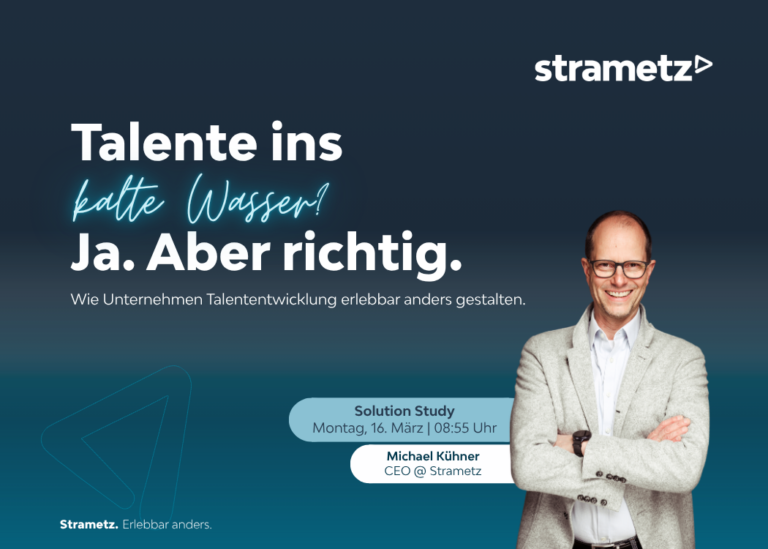
In our solution study at Talent Management Reloaded DACH, we showed what it means to turn talent development from the head to the toes. The core thesis: talents need the cold water – but they also need the life jacket.
This means that challenge and support are not a contradiction, but two sides of the same coin. Development that is challenging without being overwhelming. That is courageous without being risky. Development that is experience-oriented without being arbitrary.
What we mean by that: Creating real leadership situations before they count in everyday life.
Talents experience real leadership and decision-making situations in a protected environment. Leadership simulations make leadership behavior visible, provide orientation and enable targeted feedback – even before the first real team is led.
Feedback that does not end after the training, but accompanies you continuously. Development processes that span months and enable real changes in behavior. Diagnostics that are not a drawer, but a starting point.
3 practical examples: How companies are rethinking talent development
Theory is one thing. What we find convincing are the organizations that are already following this path – and the results they are achieving. Here are three concrete examples from our practice:
Automotive industry: Making leadership behavior visible through simulation
How do you use simulations to not only observe leadership behavior, but to make it tangible? One of our customers from the automotive industry shows how targeted simulation formats create orientation and help talents to understand and further develop their own leadership behavior at an early stage – based on diagnostics and accompanied by experienced coaches.
Insurance companies: 9 months of support instead of individual seminars
New managers at our insurance client are not left alone after a development workshop. Instead, they are supported in our Next Leader Journey over 9 months in their new role – with structured reflection phases, peer formats and continuous coaching. The result: faster development, more confidence, lower error rates in the leadership role.
Retail” sector: potential diagnostics and development go hand in hand
At a well-known company in the ophthalmic optics and hearing acoustics sector, potential diagnostics does not end with a report. It is the starting point for individual development planning: strengths are expanded in a targeted manner and development areas are addressed effectively. Linking valid diagnostics with specific development measures makes the difference between an assessment that ends up on the shelf and one that really makes a difference.
These three examples are representative of a development that we are increasingly seeing in the industry: Organizations that understand that sustainable talent development needs more than goodwill – it needs concept, continuity and the willingness to really break new ground.
Talent Management Reloaded DACH: What the conference revealed
Berlin has once again proven how lively the HR community is when it comes to thinking in truly new ways. This was particularly confirmed to us at the congress: The need for tangibly different solutions for talent and managers is real and it continues to grow.
The discussions after our presentation showed that many companies are at a turning point. They feel that traditional development formats are no longer enough. They are looking for approaches that have a measurable impact, are scalable and at the same time take the individuality of each talent seriously.
Talent development can be courageous without being risky. Challenging without being overwhelming. Experience-oriented without being arbitrary. That was our core message at the congress – and the response has encouraged us to continue on this path.
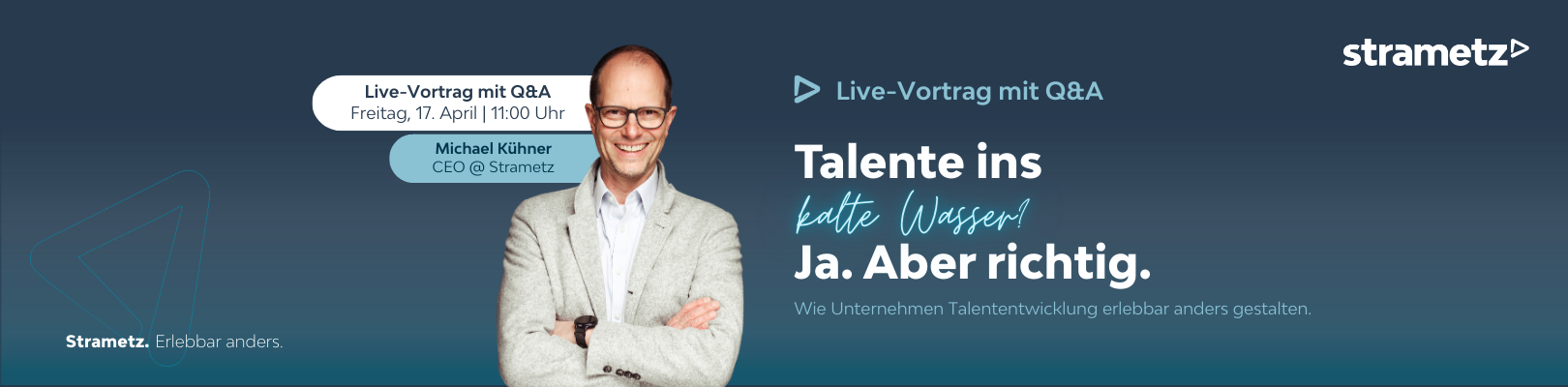
Missed the lecture? Join us live now
Live lecture on April 17, 2026, 11 a.m. – 12 p.m.
On April 17, Michael Kühner will give the congress lecture live once again – with an extended look at the current continuing education trends from the Zukunftsinstitut’s latest megatrend study and an open Q&A session.
Experience how talent development can be effectively and tangibly organized differently today.
- 📅 April 17, 2025
- ⏱️ 45 min. impulses + 15 min. Q&A
- 💻 Free live lecture